
6 Schools, Kawuku-Sisa residents join University of Kisubi students to clean a polluted community well in Katabi, reviving Buganda’s BulungiBwansi spirit
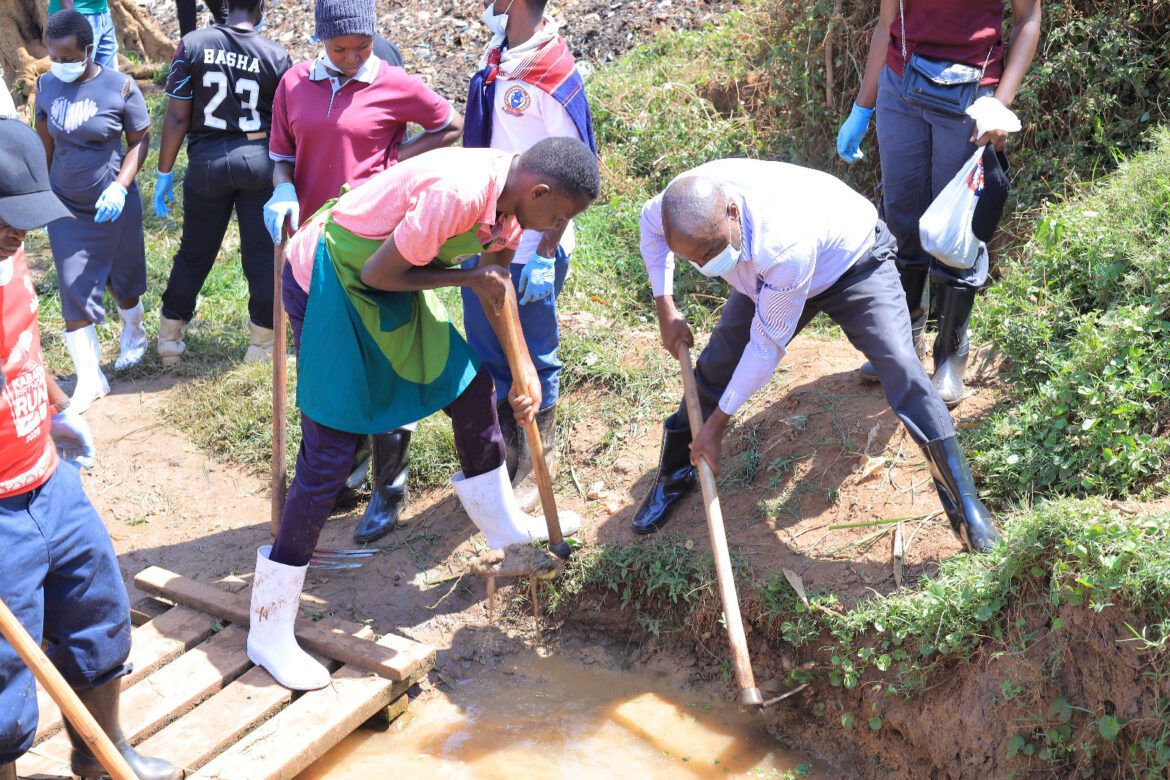
When about 300 students, teachers and residents descended on a community well in Kawuku-Sisa, Katabi Town Council, they expected to find mud, plastic and ordinary household rubbish.
Instead, they found used syringes, cotton waste, disposable diapers and other discarded materials piled beside a water source relied on by more than 1,500 households.
The discovery turned what was planned as a community cleaning exercise into a stark reminder of the health dangers facing residents who depend on traditional water sources.
“This is a health disaster in the making,” a participant said, pointing to the waste dumped meters from the well.
The well is one of the important water sources in the Kawuku Community, serving households and animals.
But years of neglect and the growth of a dumping site next to it have left residents exposed to possible contamination.
The clean-up was organised through the University of Kisubi’s Service-Learning programme, bringing together university students, local leaders, residents and learners from six schools including Kawuku Secondary School, Kitala Primary School, Kitala Secondary School, Entebbe Parents School, Boston High School and Mugezi Secondary School.
For the university, the exercise was not simply about picking rubbish.
It was a practical demonstration of how knowledge acquired in classrooms can be used to address problems affecting communities.
“Service-Learning takes students beyond the classroom. They are able to see a real problem, engage with the community and use what they have learnt to contribute to a solution,” a University of Kisubi representative said.
Students cleared waste from around the well while working alongside community members and local leadership. But the clean-up is only the beginning.
The University plans to have water samples from the well tested by its Biomedical students to establish the quality of the water and determine whether it is safe for human consumption. The results are expected to guide the next phase of rehabilitation.
The partners also plan to work with Katabi Town Council to remove the dumping site next to the well and mobilise resources to reconstruct and protect the water source. Plans include improving the well and installing pipes to make water collection safer and more efficient.
The Kawuku-Sisa intervention is part of a broader initiative under the theme “Revisiting Traditional Ways for Water Conservation and Access”.
It brings together the University of Kisubi, Buganda Kingdom’s BulungiBwansi Department, Katabi Town Council, schools and local communities.
For generations, BulungiBwansi has promoted the idea that community well being is a shared responsibility. Community wells were once more than places to fetch water.
They were meeting points where neighbors interacted, exchanged information and collectively maintained their surroundings.
“BulungiBwansi teaches us that what belongs to the community must be protected by the community. The well is not the responsibility of one person; it belongs to all of us,” one of the project participants said.
The initiative comes at a time when communities across Uganda continue to grapple with access to safe and reliable water. For poorer households, community wells can be a lifeline when piped water is unavailable or unaffordable. Even households connected to formal water systems may turn to alternative sources when supplies are interrupted. That makes the protection of traditional wells a public-health issue as much as an environmental one.
The project also reflects the Catholic tradition of care for creation and service to the vulnerable, a principle that the University of Kisubi seeks to integrate into its educational mission.
The initiative resonates with Pope Leo XIV’s September 2026 prayer intention on the care of water, which highlighted water as a universal gift and a right without borders.
The partners want to expand the initiative and progressively restore community wells across Katabi Town Council.
The ambition is to combine the traditional values of BulungiBwansi with modern approaches to public health, WASH, environmental conservation and service-learning.For the students involved, however, the most important lesson may be simpler.
They arrived at Sisa to clean a well. They left having seen first-hand how something as basic as water can connect health, poverty, environment, culture, education and human dignity.
“Water should not be treated simply as a commodity. It is a resource essential to life. Our responsibility is to protect it so that the community can use it safely today and future generations can depend on it tomorrow,” the project team said.