
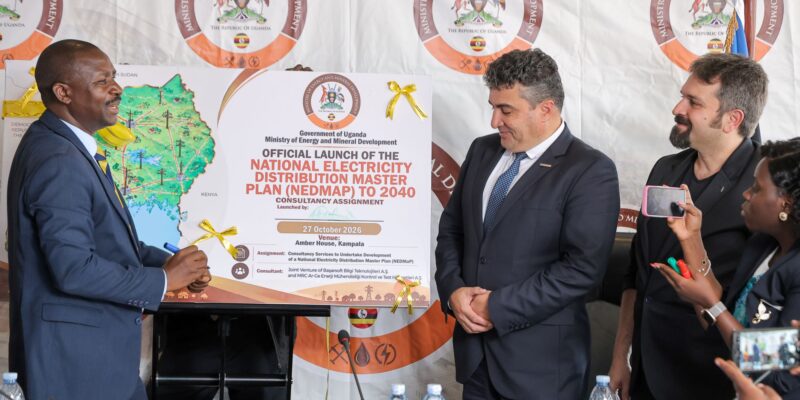
The Ministry of Energy and Mineral Development (MEMD) on Tuesday launched the development of the National Electricity Distribution Master Plan (NEDMaP), an 18-month exercise intended to guide electricity network expansion, upgrades and investment decisions across the country.
The plan comes as Uganda seeks to expand electricity access while improving the quality and reliability of supply.
It will also help address a longstanding planning problem: businesses and public facilities are sometimes established far from the electricity network, leaving government to meet the substantial cost of extending power to them.
“We have pulled wires across the country, and now the kind of planning that we need to do is more sophisticated than what we have been doing,” said Engineer Abdon Atwine, the Commissioner for Rural Electrification at MEMD, who represented the Energy Minister at the launch.
NEDMaP will operationalize the National Electrification Strategy by bringing together electricity distribution planning, rural electrification, network reinforcement and future demand projections under a coordinated framework.
The consultancy was awarded to a Turkish consortium comprising Başarsoft, which specializes in GIS and MRC, which provides power-system engineering and planning expertise.
The consultants will map existing medium and low-voltage lines, poles, transformers and other network assets, alongside settlements, roads, district boundaries, islands and important public facilities.
The exercise is expected to involve about 200 field staff, with initial field data collection projected to take approximately six months.
Eng. Abdon Atwine Atwine said the UGX 10.5 billion exercise would be funded by the government.
Geographic information systems (GIS) allows electricity infrastructure and demand to be viewed together on a digital map.
This enables planners to identify which communities are served by the grid, locate the nearest transformer to a prospective customer and assess the cost of extending or upgrading the network.
Tuncay Kucukpehlivan also Başarsoft’s general manager, said GIS would provide a reliable basis for investment decisions by showing both the existing network and planned developments.
“If there is any new demand, any new investment, like a school or the government decides to open another industrial area, you will be able to see directly on the map how you can give energy from existing infrastructure and what the cost of new investment will be,” he added.
The system is also expected to incorporate engineering models, demand forecasts and least-cost electrification plans.
Uganda’s previous electricity master plans largely focused on extending the grid to district and sub-county headquarters.
According to Atwine, that approach helped expand network coverage but did not adequately guide where schools, hospitals and large electricity consumers should be located.
The new plan will seek to match electricity demand with the capacity of the network serving each area.
The Energy Ministry says Uganda has approximately 25 percent of households connected to the national grid today, while a further 37 percent rely on off-grid solutions, including solar home systems, giving an overall electricity access rate of about 62 percent.
Under the National Electrification Strategy, the country aims to achieve universal electricity access by 2030, with approximately 50 percent of households served by the grid and the other half by off-grid solutions.
By 2040, the Energy Policy for Uganda targets increasing the share of households connected to the grid to 80 percent.
The Electricity Regulatory Authority (ERA) says the distribution network reached 96,263 kilometres by December 2025, up from 56,092 kilometres in 2021.
Eng. Atwine said the master plan would provide a common planning framework for the Energy Ministry, the Uganda Electricity Generation Company Limited (UEGCL), Uganda Electricity Transmission Company Limited (UETCL), Uganda Electricity Distribution Company Limited (UEDCL), and other relevant institutions.
It will complement the Grid Development Plan (GDP), which addresses generation and transmission, by strengthening planning for the distribution network that delivers electricity to end users.
Stakeholders also called for the study to consider distributed generation, renewable energy, electric-vehicle charging, net metering and potential off-grid solutions.