
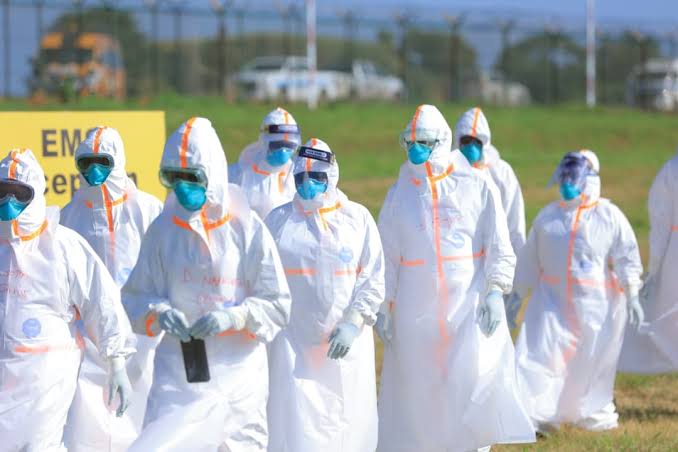
The Uganda Civil Aviation Authority (UCAA) has conducted its first Public Health Emergency Preparedness Exercise at Entebbe International Airport to test the country’s readiness to detect, contain and manage infectious disease outbreaks involving international travellers.
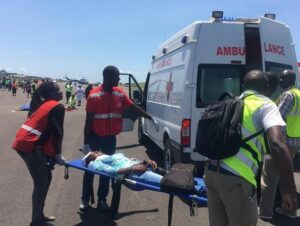
The scenario involved 76 passengers and five crew members, giving airport authorities and health workers an opportunity to assess how quickly they could identify, isolate, evaluate and manage a suspected case without disrupting normal airport operations.
The drill also tested coordination among aviation personnel, health workers, security agencies and other emergency responders in managing a potential disease outbreak that could spread across international borders.
Speaking after the exercise, UCAA Director General Fred K. Bamwesigye said protecting passengers, airport workers and the wider public requires continuous vigilance and coordinated action among different agencies.
He emphasized that responding to public health emergencies requires collective action, highlighting the importance of collaboration with the Ministry of Health and other stakeholders in preventing and containing the cross-border spread of infectious diseases.
Unlike conventional airport emergency drills, which largely focus on aviation accidents and security threats, the exercise specifically examined the airport’s capacity to respond to public health threats, including suspected infectious disease outbreaks.
Participants assessed compliance with Infection Prevention and Control (IPC) procedures, particularly the proper wearing, use and removal of Personal Protective Equipment (PPE).
The exercise also evaluated communication, reporting and coordination mechanisms to establish whether the different agencies could work effectively together when confronted with a suspected infectious disease case.
A multi-agency debriefing was held after the simulation to identify operational gaps and agree on measures to improve emergency response arrangements, Standard Operating Procedures (SOPs) and supporting infrastructure.
Bamwesigye described the exercise as a milestone in the airport’s emergency preparedness programme, noting that although Entebbe regularly conducts drills covering aviation safety and security, this was the first dedicated exercise focusing specifically on public health emergencies.
“While Entebbe International Airport regularly conducts emergency preparedness exercises covering aviation safety and security, today’s exercise marks the first time that a dedicated Public Health Emergency Preparedness Exercise has been conducted at the airport,” he said.
The exercise brought together the Ministry of Health, Uganda Airlines, Port Health, Uganda Police Force, Uganda Red Cross Society, ground handlers, the Air Operators Committee, MONUSCO and the East African Community Civil Aviation Safety and Security Oversight Agency (CASSOA), among other stakeholders.
The initiative comes amid growing calls for African countries to strengthen disease surveillance, early-warning systems and emergency response capabilities.
At the Fifth International Conference on Public Health in Africa (CPHIA 2026), African Union Commission Chairperson Mahmoud Ali Youssouf called for stronger disease surveillance and emergency response systems as part of broader efforts to improve the continent’s health security and sovereignty.
The Entebbe exercise is expected to strengthen Uganda’s preparedness at one of its key international entry points, where early detection and effective management of infectious disease threats are critical to protecting public health while sustaining international air travel.