

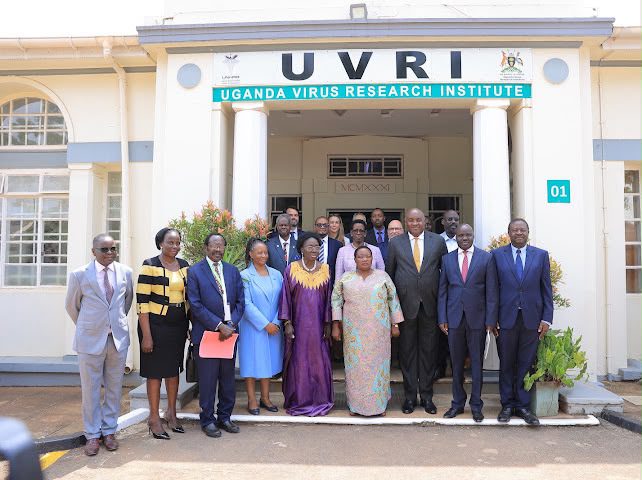
The region’s capacity to prevent, detect and respond to infectious disease outbreaks has been significantly strengthened following the official launch and operationalization of the Uganda Virus Research Institute (UVRI) as the East African Community (EAC) Regional Centre of Excellence in Virology in Entebbe, Uganda.
The Centre will serve as a regional hub for advanced virology research, specialized laboratory training, disease surveillance, diagnostics and knowledge sharing, enhancing the ability of EAC Partner States to prepare for and respond to public health threats, including Ebola, Marburg and other emerging and re-emerging viral diseases.
The event was officially launched by Uganda’s Prime Minister and Leader of Government Business, Rt. Hon. Robinah Nabbanja, representing the President of the Republic of Uganda, H.E. Yoweri Kaguta Museveni.
Speaking during the event, Hon. Nabbanja said the launch was a call to responsibility for the region to do more in strengthening health security.
She noted that the world is changing rapidly alongside evolving health demands and policies.
“Through this journey, we have seen and learnt that a nation that studies its own pathogens is a self-reliant nation. We commit to increasing funding for research,” she said.
On her part, the EAC Chairperson of the Council of Ministers, Rt. Hon. Rebecca Alitwala Kadaga, who is also Uganda’s 1st Deputy Prime Minister and Minister for East African Community Affairs, lauded the establishment of the Centre, noting that it comes at a time when infectious disease threats continue to challenge the region and the world.
“The COVID-19 pandemic demonstrated that diseases do not respect borders, and an outbreak emerging in one Partner State can quickly become a regional concern,” she noted.
While EAC Partner States have continued to strengthen their laboratory systems, differences remain in technical capacity, expertise and resources.
The operationalization of Regional Centers of Excellence provides a mechanism for Partner States to share specialized knowledge, strengthen scientific collaboration and improve collective preparedness and response.
Representing the Secretary General, EAC Deputy Secretary General in charge of Infrastructure, Productive, Social and Political Sectors, Hon. Ariik Aguer Malueth, noted that an EAC Regional Centre of Excellence is a specialized institution recognized by the Community to provide advanced expertise, research, training, innovation and technical support in an area of regional importance.
“These Centers ensure that scientific knowledge and specialized capabilities developed in one Partner State become a shared regional resource benefiting all East Africans,” he noted.
Hon. Ariik added that the EAC Regional Centre of Excellence in Virology at UVRI is among the seven Regional Medical Diagnostic Centers of Excellence identified under the EAC Health Investment Priority Framework 2018-2028, endorsed by the 19th Summit of the EAC Heads of State.
“Uganda’s leadership in virology reflects UVRI’s internationally recognized expertise and decades of contribution to virus research, disease surveillance and outbreak response,” he stated.
The event was held alongside the celebration of UVRI’s 90-year anniversary under the theme, “Celebrating 90 Years of Discoveries and Global Impact.”
Speaking at the launch, Prof. Pontiano Kaleebu, Director of the Uganda Virus Research Institute, appreciated the collaboration with the EAC and partners, affirming UVRI’s commitment to advancing regional health security.
“As a regional hub, UVRI will support advanced virology research, specialized laboratory training, diagnostics, surveillance and knowledge sharing across the EAC region,” he said.
The Centre will strengthen the ability of Partner States to detect, confirm and respond to viral diseases through enhanced laboratory networks and scientific collaboration.
UVRI already plays an important regional role by supporting confirmation of samples referred from Partner States before disease outbreaks are declared, ensuring that public health decisions are guided by scientific evidence.(By Our Reporter)