
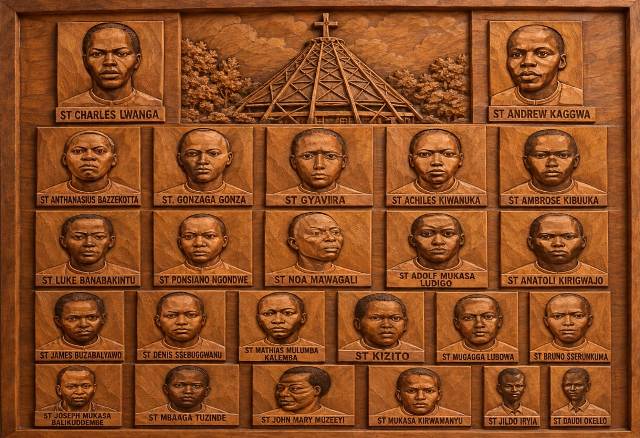
At Michelangelo College of Creative Arts (MCCA), Kisubi, a research project is bringing Uganda’s history of Christian martyrdom into a distinctive artistic form: a wooden high-relief sculpture portraying the Uganda Martyrs.
The interdisciplinary project, running from January to October 2026, brings together Rev. Bro. Frederick Musaazi (BSCL) of the Michelangelo Iconographic Church Art Studio, Kisubi, and Prince Mawanda Charles Don Edwarles, through Kirles Digital Studioz, under the MCCA Directorate of Research, Academic Development and Community Engagement.
The project seeks to demonstrate how sculpture can become more than an object of devotion or decoration. It can also function as a historical text, educational resource, cultural record and instrument for preserving collective memory.
The Uganda Martyrs occupy a central place in Uganda’s religious and cultural heritage. On October 18, 1964, Pope Paul VI canonized Charles Lwanga, Matthias Mulumba Kalemba and 20 companions, formally recognizing them as saints. In his canonization homily, Paul VI explicitly described them as “sons of Africa,” emphasizing their African identity and the significance of their witness.
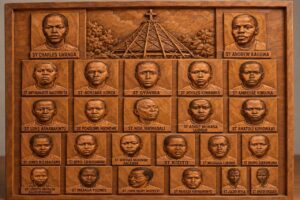
Their story is rooted in the persecution of Christians in the Kingdom of Buganda during the period 1885–1887. Thirteen of the 22 Catholic Martyrs were taken to Namugongo and killed there on June 3, 1886, while others suffered martyrdom at different locations.
Today, Namugongo has become one of Africa’s major Christian pilgrimage destinations and an important site of Ugandan historical memory.
For the MCCA researchers, translating this history into wood presents both an artistic opportunity and a responsibility.
Wood as historical memory
The choice of wood is significant. As a traditional and widely used material in African artistic practice, wood provides a natural connection between contemporary Christian art and African visual heritage.
High relief also offers the artists an opportunity to move beyond a flat historical illustration. Figures, gestures, clothing, facial expressions and symbolic elements can be brought forward from the wooden surface, creating a visual narrative that encourages viewers to engage with the Martyrs as people within a historical story.
The sculpture is therefore conceived not simply as a representation of individual saints, but as an artistic interpretation of faith, courage, identity, sacrifice and memory.
The research process combines historical inquiry, Catholic iconographic principles, artistic experimentation, sculpture practice and digital documentation. Particular attention is given to distinguishing documented historical information from artistic interpretation.
From studio to digital archive
A further dimension of the project is digital documentation.
Through Kirles Digital Studioz, the artistic process is being approached as a record in its own right—from conceptual development and preparation of the wood to carving, detailing, finishing and presentation.
Such documentation can help preserve knowledge about the making of the sculpture while providing material for future teaching, exhibitions, publications and digital heritage initiatives.
The project also proposes educational applications, including a textbook and research materials that can help students and the wider public understand the relationship between history, faith, art and cultural heritage.
An African Christian story
The artistic interpretation also raises a broader question: how can African Christian history be represented through African artistic languages
Pope Paul VI’s 1964 canonization homily emphasized the African identity of the Martyrs, while Pope John Paul II later described the Martyrs’ witness at Namugongo as a light for Africa and connected their story with Africa’s identity in the Christian faith.
For MCCA, this provides an important foundation for exploring Christian iconography through local artistic knowledge rather than treating African subjects merely through imported visual conventions.
The resulting sculpture is consequently positioned at the intersection of religion, African identity, history, sculpture and education.
Preserving memory for another generation
The Uganda Martyrs have survived in oral tradition, written history, liturgical celebrations, pilgrimage, monuments and visual art. The MCCA project adds another layer to that continuing tradition.
Its central proposition is straightforward: historical memory can be preserved not only in books and archives, but also in carefully researched works of art.
By combining traditional craftsmanship with contemporary research and digital documentation, the project seeks to create a work capable of speaking simultaneously to worshippers, students, artists, researchers, pilgrims and the wider public.
As the wooden figures gradually emerge from the material, the project at Kisubi is ultimately asking viewers to encounter an old story in a new form—a story of young African Christians whose witness became part of Uganda’s religious heritage and, eventually, the universal history of the Catholic Church.( By Don Edwarles MKM)
NB:The is a writer, researcher and digital documentation practitioner associated with creative arts and heritage research in Uganda.