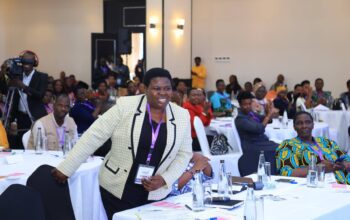

Two girls are born in the same setting, using the same dusty roads, have the same opportunities.
Yet, as they grow, one is molded to think that her place stops in the household, while the other is taught that she can, and should, take on the world.
Two girls, same opportunities but very varying mindsets of mentors. This is a cold reflection of what is happening in society.
As we mark International Women’s Day 2026 under the theme “Give to Gain,” we need to have a real conversation.
We spend a lot of time celebrating the women already at the top, and forget that real change doesn’t begin when a woman reaches the ballot box; it begins with the intentional, grassroots support a girl receives long before she hits adulthood.
The truth is, for millions of girls in East Africa and beyond, the race is rigged before it even starts.
While their peers move ahead, many girls are held back by the invisible weight of unpaid domestic chores, teenage pregnancies, and a ‘leaky pipeline’ that sees them lose out far earlier than boys.
In Uganda, for example, we have technically achieved gender parity at the primary level, with gross enrollment sitting at roughly 119% for both girls and boys as of 2024 according to the Uganda Bureau of Statistics (UBOS) and the 2024 Uwezo Learning Assessment.
This equality is a deceptive snapshot.
By the time they reach secondary school, enrollment for girls falls to just 33%, and the gap widens even further in higher education.
When we cap a girl’s potential with outdated expectations or fail to provide the support she needs to stay in school, we aren’t just failing her, we are draining our future economy.
However, there is a piece of the puzzle we often ignore in every equality conversation;
The boys. If we empower our daughters to be leaders, but leave our sons trapped in old definitions of dominance, we are setting the stage for conflict, not progress.
True grassroots empowerment must include young boys and men. We need to teach them that a woman’s success isn’t a threat to their own, but a boost to their families and communities.
We need to raise a generation of men who are secure enough to be partners, collaborators, and champions of the women in their lives.
The fix isn’t going to come from high-level summits alone. It comes from meeting girls exactly where they are.
We need to focus onlocal mentors, where we let a primary school girl see a woman from her own community running a business or a local office, we make sure a girl in a rural district has the same shot at managing finances as a girl in the city, and let’s talk to parents so they see a daughter’s education as a long-term asset, not a domestic loss.
When change starts locally, it sticks. We are seeing this happen when the private sector starts treating social responsibility like an investment.
Take the East African Crude Oil Pipeline (EACOP), for instance. Beyond the pipes and infrastructure, they’ve put resources into things that will keep girls in class, like distributing dignity hampers (sanitary supplies) to primary students, fixed up vocational hubs like the Don Bosco center.
By tackling issues like gender-based violence and health education on the ground, they’re helping create a safer environment for the next generation of workers.
But this isn’t just a job for one company or one NGO. It’s on all of us. Governments need to fix the legal loopholes that leave girls vulnerable.
Educators need to stop seeing leadership as a male trait.
And to the parents: your belief in your daughter is more powerful than any government policy ever written.
This International Women’s Day, let’s move past the speeches and get practical. Every strong woman we admire today is simply a girl who was once given a book, a mentor, or a fair shot, and had a young boy standing next to her, cheering her on.
If we invest in girls now, they won’t need us to empower them when they grow up, they will already be unstoppable.
Doreen Komugisha is a Brand Experience Manager, and an advocate for the girl child.