

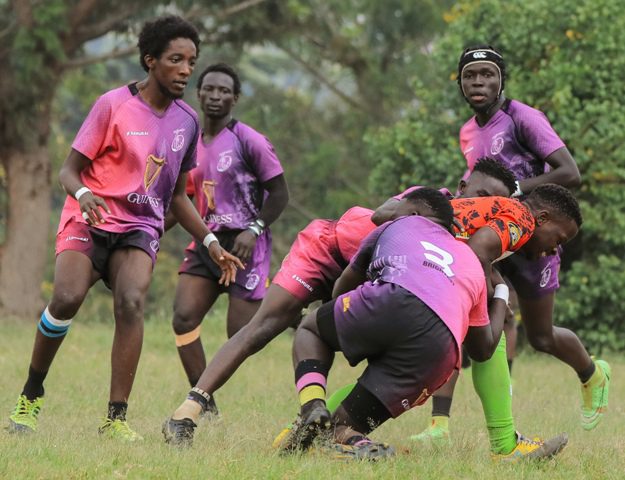
Kisubi 7s demonstrates how university education can respond directly to community needs
The rugby pitch at the University of Kisubi came alive with more than sporting competition during the second round of the Central 7s Series, as the institution transformed the Kisubi 7s tournament into an innovative practical learning environment for its nursing students.
Hosted by Kisubi Pacers RFC, a community rugby club based at the University of Kisubi, under the theme “Community Partnerships,” the tournament brought together eight men’s and four women’s teams. Beyond the excitement of rugby, the event demonstrated how Service Learning can bridge the gap between classroom knowledge and real-life community needs.
From the classroom to the rugby pitch
Through the University of Kisubi Service Learning Programme, participating rugby teams were paired with student nurses who worked alongside team medical personnel throughout the tournament.
The student nurses supported players and responded to medical needs during the matches, giving them an opportunity to apply their classroom knowledge in the fast-moving and demanding environment of competitive sport.
For the rugby teams, the initiative provided additional trained medical support. For the students, meanwhile, the tournament became a practical laboratory where they could develop skills in sports first aid, teamwork, communication, rapid assessment and decision-making.
This is precisely the philosophy behind Service Learning: students learn through service while communities benefit from the knowledge and skills generated within the university.
A rugby tournament becomes a learning laboratory
The Kisubi 7s experience demonstrated that university-community engagement does not have to be restricted to conventional outreach programmes.
A sporting event, when properly organised through strategic partnerships, can become a powerful platform for professional development, community service and experiential education.
The rugby pitch effectively became a “living classroom”, exposing student nurses to situations that cannot always be fully recreated through lectures, demonstrations or laboratory sessions.
Working alongside experienced team medics also enabled the students to understand the unique demands of providing first aid in a sporting environment.
Call for World Rugby First Aid training
The success of the student nurses attracted recognition from Regional Development Officer Mr. Asiimwe Keith, who commended them for their contribution to the tournament.
He encouraged the students to consider undertaking World Rugby First Aid courses, potentially opening a pathway towards professional involvement in sports medicine and rugby medical services.
The encouragement appears to have resonated with the students.
Following the tournament, the student nurse volunteers expressed interest in pursuing the World Rugby First Aid (FAIR) course, with the ambition of developing competencies that could enable them to become qualified Rugby Level 1 medics.
What began as an opportunity to volunteer at a rugby tournament therefore opened a potential new professional direction for the students.
University-community partnership in action
The Kisubi 7s initiative reflects a broader vision of the University of Kisubi as an engaged university—an institution that does not only teach communities from within lecture rooms but also learns with, serves and grows alongside them.
The programme brought together nursing students, rugby clubs, athletes, team medics and university staff around a common purpose.
University representatives included Br. Dr. Bernard Luwerekera, Coordinator of the Service Learning Programme; Mr. Kimuli Julius, 14th Guild President; and Ms. Namirimo Daisy, President of the Service Learning Club. The initiative was coordinated by Mr. Senteza Charles.
Their participation demonstrated the importance of institutional leadership in creating meaningful opportunities for students to connect academic learning with community realities.
Beyond the scoreboard
While rugby matches are ultimately decided by scores, tries and victories, the Kisubi 7s produced a different kind of victory—one that could not be measured on the scoreboard.
Students gained practical experience. Rugby teams received additional medical support.
The university strengthened its relationship with the surrounding sporting community. And the wider community benefited from university knowledge and professional skills.
The Kisubi 7s therefore offers a compelling example of how higher education institutions can rethink community engagement.
Instead of viewing learning and service as separate activities, the University of Kisubi demonstrated that education can happen through service, and service can become an essential part of education.
The experience also points towards greater possibilities for collaboration between universities and sporting organisations, particularly in areas such as sports medicine, physiotherapy, nutrition, psychology, rehabilitation, public health and emergency response.
For the student nurses who stepped onto the rugby pitch, the Kisubi 7s was more than a tournament.
It was a classroom without walls—and a reminder that some of the most important lessons in higher education are learned by stepping outside the classroom and serving the community.