

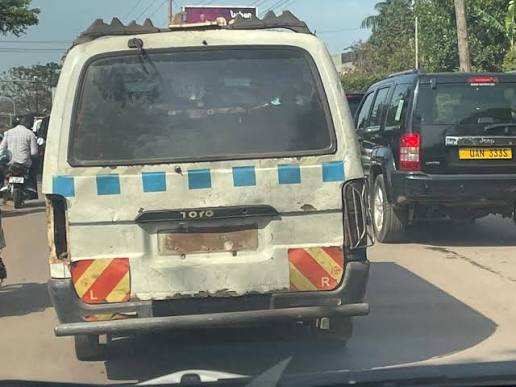
KAMPALA, Uganda — The government is set to begin a 100-day crackdown on old rotting and mechanically unsafe taxis operating in the Greater Kampala Metropolitan Area, with authorities warning that vehicles popularly known as “ganyegenya” will no longer be allowed on the roads.
Works and Transport Minister Fred Byamukama announced the enforcement on Thursday, saying the operation is intended to address dangerous vehicles that continue to carry passengers despite having serious mechanical defects.
Under the directive, police will impound taxis found to be in a dangerous mechanical condition and take them to a parking facility provided by the Kampala Capital City Authority (KCCA) in the Nakawa area.
Byamukama stressed that the government was not banning taxis or attempting to end the taxi business. Instead, he said, the focus was on vehicles that have deteriorated to a point where they pose a danger to passengers, drivers and other road users.
“We have not banned the business of taxis, no. We love the business of taxis, and we are supporting them, but we have banned ‘Ganyegenya’ taxis in Greater Kampala and the surrounding areas for the first phase,” the minister said.
He warned taxi operators against attempting to return the targeted vehicles to the roads after Monday.
“With effect from Monday, don’t bring back these ‘ganyegenya‘ cars in Kampala and surrounding areas,” Byamukama said.
The minister said some of the vehicles targeted by the operation have serious defects, including worn-out tyres, faulty brakes and steering systems, damaged seats and defective doors.
In some cases, he said, drivers have been forced to hold doors shut while driving, creating an additional risk for passengers.
“Some of these taxis are DMCs and are not acceptable on the roads,” he said. “At some point you find a driver driving while holding the door, which is risky for passengers and the driver himself.”
Byamukama further claimed that some of the vehicles being operated as public taxis are rebuilt from cars that had previously been involved in accidents and abandoned in garages.
According to the minister, some owners purchase such vehicles cheaply, carry out limited repairs and return them to the road.
These are cars which are worn out.
These are cars which got accidents some time back, and the owners abandoned them in the garages, he said.
But our own Ugandans buy them from these garages at a very cheap cost.
They just put tyres and bring them on the road.
The government says it has already given operators an opportunity to demonstrate that their vehicles are safe through voluntary inspections.
Byamukama said sample inspections carried out over the past 60 days did not produce a single vehicle that met the required road worthiness standards.
“If you are proving to government your car is not ‘ganyegenya’, take it for inspection.
It will not pass.
We have tested some voluntarily for the last 60 days, but none of them has passed,” he said.
Reports have estimated that between 30 and 60 ageing taxis were subjected to the voluntary inspection exercise.
The first phase of the enforcement campaign will cover Kampala, Wakiso and Mukono.
The government plans to extend the operation to other parts of the country after the initial phase.
“We have brought a hundred days of operation ‘Ganyegenya‘ in Greater Kampala and the surrounding areas,” Byamukama said, adding that police had been directed to enforce the rules.
The latest announcement follows an earlier government attempt to address the problem in March, when taxi owners were given 20 days to repair or remove vehicles considered unroadworthy.
Taxi operators subsequently asked authorities for more time, arguing that many owners could not afford the cost of major repairs and that abrupt enforcement could threaten the livelihoods of people who depend on the industry.
The Uganda Taxi Operators Federation, under chairperson Rashid Ssekindi, also called for more consultation and warned that enforcement could have consequences for drivers, conductors, owners and other workers whose incomes depend on public transport.
Operators have previously argued that poor road conditions also contribute to the deterioration of taxis, particularly vehicles operating on heavily damaged routes.
The Kampala metropolitan area is estimated to have about 15,000 taxis, making the sector one of the most important sources of public transport for residents travelling between Kampala, Wakiso and Mukono.
The government has made clear that taxis that pass inspection and meet safety requirements will remain on the roads. Owners of vehicles found to be unsafe will be expected to repair, replace or withdraw them from passenger service.
The enforcement could nevertheless create short-term challenges for commuters, particularly on routes that rely heavily on older taxis.
Passengers have consequently been advised to plan their journeys from Monday, when police are expected to begin impounding vehicles identified as dangerous.
The crackdown comes against the backdrop of continuing concerns over road crashes in Uganda, with mechanical failures, overloading, dangerous driving and other violations frequently cited among the factors contributing to road deaths and injuries.
For the government, the operation represents an effort to enforce existing safety requirements and remove dangerous vehicles from public transport.
For taxi operators, it is likely to bring renewed pressure to invest in repairs and newer vehicles while raising questions about the cost of compliance and the impact on livelihoods.
The coming weeks will show how widely the directive is enforced and whether the removal of unsafe taxis results in a safer public transport system without creating major disruptions for commuters.