
BY DAVID ISABIRYE
African Coffee Hub, supported by the IDB, Launches the Regional Program
8 African Nations Mobilized
• First Wave of Memoranda of Understanding Signed
• Key Commitment from Nigeria, through AGARA, for the Future African Coffee Research Center.
A New Value Framework is Being Written from Tangier Med.
THE CONTINENTAL THESIS
Africa produces nearly 15% of the world’s coffee but captures less than 10% of its final value; nearly 80% of the volume is exported as non-standardized green beans, and farmers receive only between 1% and 10% of the final price. African Coffee Hub, conceived and chaired by Sanae Benabdelkhalek, was designed to reverse this equation between production and final marketing: consolidation of origins, quality harmonization, digital traceability, blending, packaging, and export logistics from Tangier Med.
THE MARRAKECH FORUM
• MAY 5 & 6, 2026
African Coffee Hub co-organized, with the Islamic Development Bank (IsDB) and the Organisation of Islamic Cooperation (OIC), the Regional Forum laying the foundations for the Regional Program for the Development of the Coffee Value Chain in Africa.
The program aligns with the royal directives of His Majesty King Mohammed VI for South-South cooperation and with the IsDB Group’s Ten-Year Strategic Framework 2026-2035.
A FIRST WAVE OF AGREEMENTS SEALED:
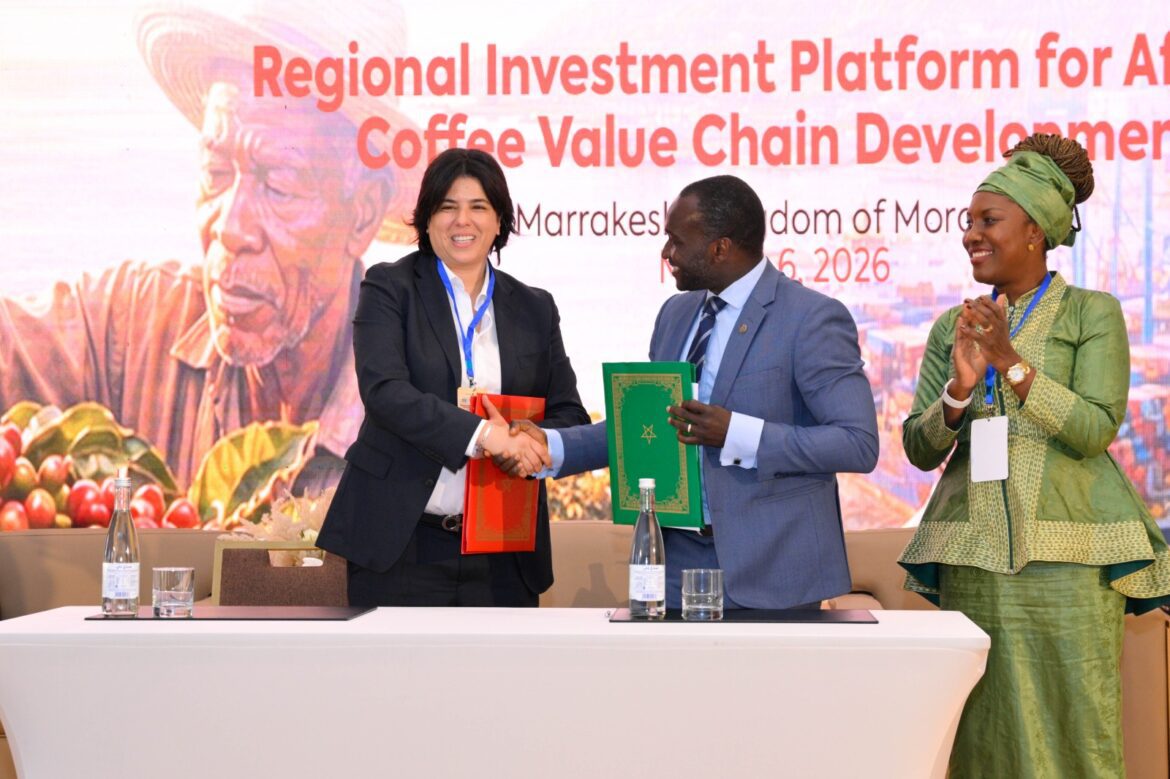
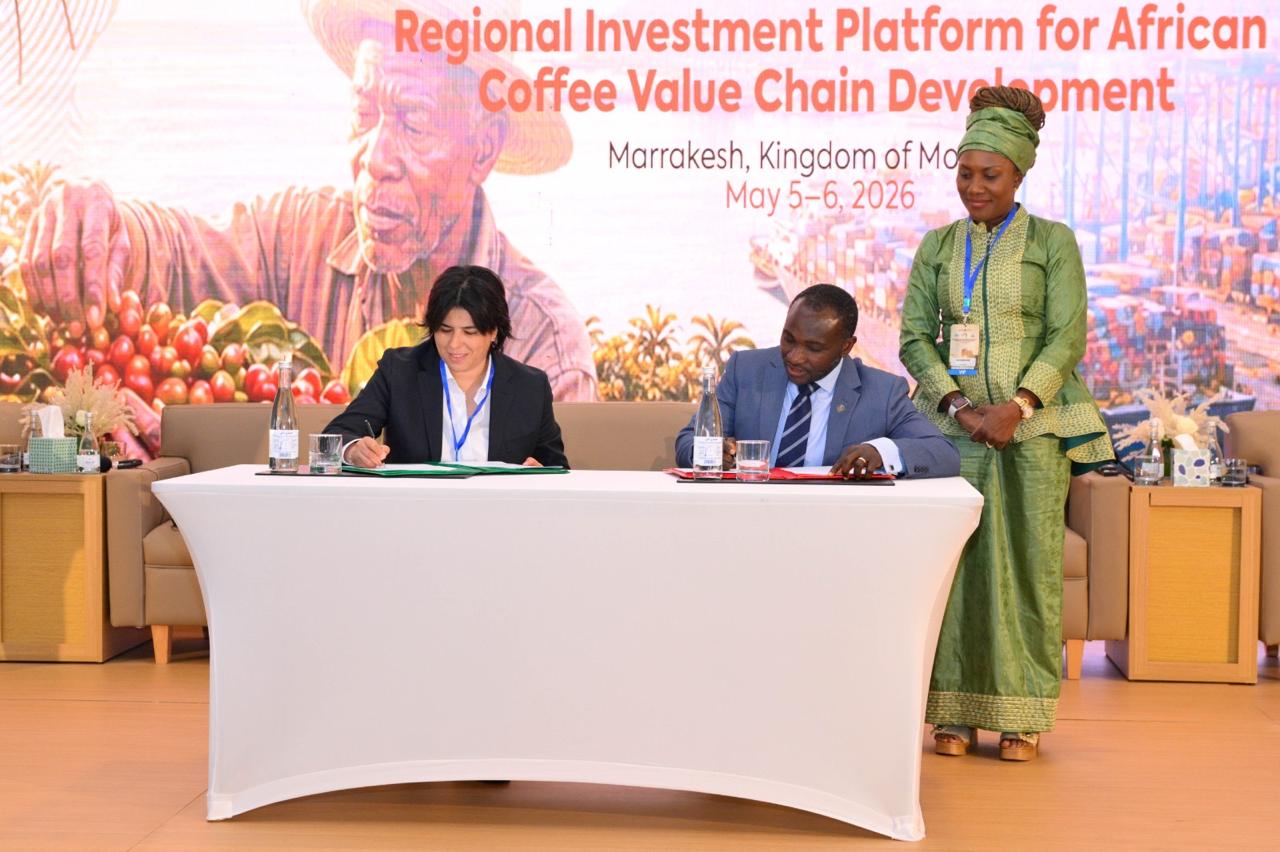
African Coffee Hub signed Memoranda of Understanding (MOU) with the Ministers of Agriculture of Sierra Leone, Guinea (accompanied by their counterpart from the Ministry of Finance), and Madagascar, as well as with Banta African Coffee Ltd in Uganda, headed by Mr. Nzeire Kaguta, brother of the President of the Republic.
Sierra Leone is also paving the way for $65 million in structuring funding dedicated to national agribusiness (Feed Salone program) and is highlighting Stenophylla coffee, a rare heat-resistant variety.
NIGERIA AT THE FOREFRONT:
• AGARAAGARA has committed 2,000 hectares to the African Coffee Hub and made 1,000 m² available to the OIC and the IDB for the construction of the largest coffee research center in Africa, under the management and supervision of the African Coffee Hub.
The Moroccan platform thus becomes a leading operator, operationally, scientifically, and technically, within the African coffee value chain.
MOROCCO, A STRATEGIC LINK IN THE AFRICAN VALUE CHAIN:
Morocco does not produce coffee. And yet, through African Coffee Hub, a platform conceived, installed, and launched from the Kingdom, it integrates into the continental value chain as a complementary and essential link: not a transit point, but a central player responsible for sorting, aggregation, quality control, blending, digital traceability, and accelerating access for African coffee to end markets in Europe and North America.
This positioning rests on a unique geostrategic convergence: the royal directives of His Majesty King Mohammed VI for South-South cooperation with sub-Saharan Africa; the logistical power of Tangier Med, a leading port hub connected to the world’s main shipping routes; the agronomic expertise of OCP Africa dedicated to soil health, a prerequisite for coffee quality; and the diplomatic capital patiently built by the Kingdom on the continent.
The deployment is taking place in two phases. Phase 1: agriculture, producer aggregation, post-harvest standardization, yield optimization, first export flows via Tanger Med.
Phase 2: certification, NFC traceability and identifiable bagging respecting the identity of origin of each producing country, in accordance with international ethical and professional standards.
INSTITUTIONAL ARCHITECTURE
• THREE IDB PILLARS Sectoral: applying proven expertise from other sectors (rice, cassava, cotton, cereals) to the coffee sector.
Financial: leveraging ITFC (trade finance), ICIEC (export credit insurance), and ICD (private investment). Inclusive: microfinance targeting cooperatives, SMEs, women (over 60% of the workforce), and rural youth. Additional contributions from IOFS (evidence-based methodology), ICDT, and OCP Africa.
Regulatory framework: AfCFTA.
EIGHT NATIONS MOBILIZED
•A CONTINENTAL CRITICAL MASS:
Sierra Leone • Guinea • Madagascar • Uganda • Togo • Cameroon • Côte d’Ivoire • Kingdom of Morocco, with additional structural commitment from Nigeria through AGARA.
This mobilization constitutes the first operational coalition of African coffee origins, covering West Africa, Central Africa, East Africa, and the Indian Ocean.
The strategic impact is threefold: aggregation of a critical mass of supply capable of influencing global price formation; harmonization of quality standards and traceability across all participating origins; and disintermediation of parasitic distribution channels and direct access for producers and cooperatives to end markets, under the umbrella of a single African operator.
The historical fragmentation of African supply gives way to consolidated negotiating power, directly connected to global demand via Tanger Med.
MARKET BENCH-MARKS:
Global coffee market: $245.2 billion in 2024, projected $380 billion in 2034 (CAGR 4.5%). The sector supports 100 million people, including 12 to 15 million smallholder farmers directly involved in cultivation.
A NEW MODEL OF COOPERATION:
The triangulation of sovereignty × finance × implementation forms the basis of African economic cooperation founded on measurable operational effectiveness: producing states support the upstream sector, the financial institution provides the framework and capital, and African Coffee Hub ensures implementation.
This model is intended to serve as a benchmark for other African value chains: cocoa, cashew nuts, and mangoes.
“This is not only about economic rebalancing, but also about the distribution of power.” Sanae Benabdelkhalek, President of African Coffee Hub.